


Memorial to the Victims
of the Nazi Justice System
“But we wish to erect monuments in your memory”
(Ricarda Huch)
Memorial to the Victims of Nazi Justice at the German Judges’ Academy in Trier
In memory of the men and women who suffered injustice during the Nazi regime in the name of the German people, a memorial was erected at the German Judges’ Academy in Trier in 1989. The artistic design of the memorial is by the sculptor Gabriele Marwede, born in 1925. It was selected from among 10 submitted designs in a competition organised by the Federal Ministry of Justice.
Gabriele Marwede provided the following explanation of her design:
“In order to make the oppressive events and the burdensome past tangible in a memorial through a sculpture, it seemed to me essential to avoid anything ‘literary’.
For my design, I chose a ‘head’ in order to place the emphasis on individual fates, on the individual human being, as both victim and perpetrator.”
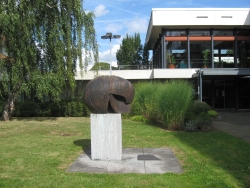
The sculpture, with its concealed eyes, is intended to symbolise
- the absence of justice under Hitler’s tyranny and abuse of power,
- resistance
- the refusal of the individual to conform, who suffers and dies for his convictions,
- action driven by personal conscience and moral duty – against the Nazi regime,
- a shielding from extreme horror.
The thousands of death sentences handed down by the criminal justice system in the Third Reich remain, in a sense, abstract; not so the individual, tangible fate. This fate always had to be lived through – often in great isolation – right up to death.
Yet the head also expresses that physical annihilation is not the end.
The head’s very closed outline, the solemn, compact, dark bronze, corresponds to my conception of the rigour of the overall composition.
The plinth should consist of light, dense shell limestone and be surrounded by large, roughly sawn slabs of the same material.
The bronze plate set into the floor with its sharp angle represents an element fundamentally opposed to the organic form of the head, one that evokes violence.
I envisage the head being positioned at eye level. Placing it before the eyes is done in the hope of prompting the viewer to reflect very directly, to sharpen their awareness of the individual’s responsibility (and guilt) – that is, not to shift personal responsibility onto a higher-level system or a higher authority.
In this way, the aim is to evoke a sense of concern, a stimulus to engage with the role of the judiciary in the Third Reich.
Gabriele Marwede
Documentation of the competition
In 1989, the Federal Ministry of Justice published a document detailing the competition it had organised for the construction of the memorial. In it, the then Federal Minister of Justice, Hans A. Engelhard (1939–2008), addresses visitors to the German Judges’ Academy:
“To the visitors of the German Judges’ Academy!
“In the abyss of injustice, you will always find the greatest care taken to maintain the appearance of law.”
This sentence, written by Pestalozzi over 100 years before Hitler’s rise to power, captures precisely the essence of the German judiciary’s entanglement in the Nazi system of injustice. It was lawyers who upheld the pretence of the rule of law, who interpreted existing law in a National Socialist sense and who ultimately acted as part of the machinery of extermination against political opponents and racial minorities.
After the war, the Germans were confronted with the full extent of the Nazi reign of terror. But instead of facing up to their own history, the past was repressed and downplayed. Legal professionals were also among those who succeeded in trivialising their involvement in the system of injustice: hardly anyone was held to account. Only today – more than 40 years after the end of the Nazi dictatorship – are we asking more clearly and openly about the judiciary’s complicity in the injustices of that time and about the failures of the post-war years.
We can only achieve an honest engagement with the past, a genuine sense of empathy with the events of that time and a true sense of shock at the unbelievable crimes if we keep the memory of the victims alive.
The memorial to the victims of the Nazi judiciary at the Judicial Academy in Trier is intended to encourage you, who are here today, to engage with history, to constantly examine your own thoughts and actions, and to remain vigilant in ensuring that the judiciary remains one of the guarantors of the liberal constitutional state. It is also intended to help preserve your capacity for compassion and for identifying with the victims.
Hans A. Engelhard
Federal Minister of JusticeThe nine-member jury for the competition also included two representatives of the White Rose Foundation. Its then chairman and current honorary chairman, Franz J. Müller, wrote the following contribution for the documentation of the art competition:
“But we wish to erect monuments in your memory”
(Ricarda Huch 1945, from a poem to the victims of the German resistance)
The People’s Court sentenced over 5,000 men and women to death, and even more to long prison terms.
The Nazi special courts handed down similar ‘judgements’. Bitter injustice for so many, great suffering for their families …
More than 40 years on, there is no site of remembrance and commemoration of this. More than 40 years on, however, all investigations against judges and public prosecutors of the People’s Court have been dropped.
It remains an incomprehensible fact that the judiciary of the Federal Republic of Germany after 1945 did not clear its terrible burden from the Nazi era, did not subject itself to catharsis.
The memorial to the victims of the Nazi judiciary, which has now been erected at the Judges’ Academy in Trier, was consequently not initiated by the judiciary, but by survivors of the German Resistance.
From ten designs submitted for Trier, the jury – which included two representatives of the White Rose – agreed to recommend Ms Marwede’s sculpture. The reticence, the aloofness of this design compels one to engage with it, to penetrate it. We at the White Rose believe that in doing so, we have helped to choose a challenging symbol.
We hope that, following Trier, a memorial in Karlsruhe will also commemorate the victims of the Nazi judiciary.
White Rose Foundation
Franz J. Müller
First Chairman
Memorial to the Victims
of the Nazi Justice System
“But we wish to erect monuments in your memory”
(Ricarda Huch)
Memorial to the Victims of Nazi Justice at the German Judges’ Academy in Trier
In memory of the men and women who suffered injustice during the Nazi regime in the name of the German people, a memorial was erected at the German Judges’ Academy in Trier in 1989. The artistic design of the memorial is by the sculptor Gabriele Marwede, born in 1925. It was selected from among 10 submitted designs in a competition organised by the Federal Ministry of Justice.
Gabriele Marwede provided the following explanation of her design:
“In order to make the oppressive events and the burdensome past tangible in a memorial through a sculpture, it seemed to me essential to avoid anything ‘literary’.
For my design, I chose a ‘head’ in order to place the emphasis on individual fates, on the individual human being, as both victim and perpetrator.”
The sculpture, with its concealed eyes, is intended to symbolise
- the absence of justice under Hitler’s tyranny and abuse of power,
- resistance
- the refusal of the individual to conform, who suffers and dies for his convictions,
- action driven by personal conscience and moral duty – against the Nazi regime,
- a shielding from extreme horror.
The thousands of death sentences handed down by the criminal justice system in the Third Reich remain, in a sense, abstract; not so the individual, tangible fate. This fate always had to be lived through – often in great isolation – right up to death.
Yet the head also expresses that physical annihilation is not the end.
The head’s very closed outline, the solemn, compact, dark bronze, corresponds to my conception of the rigour of the overall composition.
The plinth should consist of light, dense shell limestone and be surrounded by large, roughly sawn slabs of the same material.
The bronze plate set into the floor with its sharp angle represents an element fundamentally opposed to the organic form of the head, one that evokes violence.
I envisage the head being positioned at eye level. Placing it before the eyes is done in the hope of prompting the viewer to reflect very directly, to sharpen their awareness of the individual’s responsibility (and guilt) – that is, not to shift personal responsibility onto a higher-level system or a higher authority.
In this way, the aim is to evoke a sense of concern, a stimulus to engage with the role of the judiciary in the Third Reich.
Gabriele Marwede
Documentation of the competition
In 1989, the Federal Ministry of Justice published a document detailing the competition it had organised for the construction of the memorial. In it, the then Federal Minister of Justice, Hans A. Engelhard (1939–2008), addresses visitors to the German Judges’ Academy:
“To the visitors of the German Judges’ Academy!
“In the abyss of injustice, you will always find the greatest care taken to maintain the appearance of law.”
This sentence, written by Pestalozzi over 100 years before Hitler’s rise to power, captures precisely the essence of the German judiciary’s entanglement in the Nazi system of injustice. It was lawyers who upheld the pretence of the rule of law, who interpreted existing law in a National Socialist sense and who ultimately acted as part of the machinery of extermination against political opponents and racial minorities.
After the war, the Germans were confronted with the full extent of the Nazi reign of terror. But instead of facing up to their own history, the past was repressed and downplayed. Legal professionals were also among those who succeeded in trivialising their involvement in the system of injustice: hardly anyone was held to account. Only today – more than 40 years after the end of the Nazi dictatorship – are we asking more clearly and openly about the judiciary’s complicity in the injustices of that time and about the failures of the post-war years.
We can only achieve an honest engagement with the past, a genuine sense of empathy with the events of that time and a true sense of shock at the unbelievable crimes if we keep the memory of the victims alive.
The memorial to the victims of the Nazi judiciary at the Judicial Academy in Trier is intended to encourage you, who are here today, to engage with history, to constantly examine your own thoughts and actions, and to remain vigilant in ensuring that the judiciary remains one of the guarantors of the liberal constitutional state. It is also intended to help preserve your capacity for compassion and for identifying with the victims.
Hans A. Engelhard
Federal Minister of JusticeThe nine-member jury for the competition also included two representatives of the White Rose Foundation. Its then chairman and current honorary chairman, Franz J. Müller, wrote the following contribution for the documentation of the art competition:
“But we wish to erect monuments in your memory”
(Ricarda Huch 1945, from a poem to the victims of the German resistance)
The People’s Court sentenced over 5,000 men and women to death, and even more to long prison terms.
The Nazi special courts handed down similar ‘judgements’. Bitter injustice for so many, great suffering for their families …
More than 40 years on, there is no site of remembrance and commemoration of this. More than 40 years on, however, all investigations against judges and public prosecutors of the People’s Court have been dropped.
It remains an incomprehensible fact that the judiciary of the Federal Republic of Germany after 1945 did not clear its terrible burden from the Nazi era, did not subject itself to catharsis.
The memorial to the victims of the Nazi judiciary, which has now been erected at the Judges’ Academy in Trier, was consequently not initiated by the judiciary, but by survivors of the German Resistance.
From ten designs submitted for Trier, the jury – which included two representatives of the White Rose – agreed to recommend Ms Marwede’s sculpture. The reticence, the aloofness of this design compels one to engage with it, to penetrate it. We at the White Rose believe that in doing so, we have helped to choose a challenging symbol.
We hope that, following Trier, a memorial in Karlsruhe will also commemorate the victims of the Nazi judiciary.
White Rose Foundation
Franz J. Müller
First Chairman
Information
How to get here

Information
How to get here