
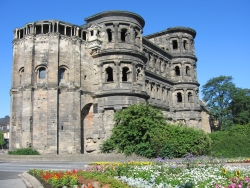
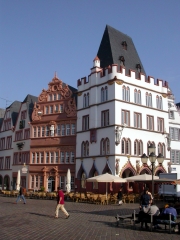
Even today, it offers visitors an impressive stroll through antiquity, past the city’s landmarks: the Porta Nigra, the best-preserved city gate from Roman times; the Palastaula, the former throne room of Emperor Constantine; the amphitheatre, which once accommodated and entertained some 20,000 spectators; the still imposing remains of the extensive thermal baths; the Roman Bridge, a technical masterpiece that, after nearly 2,000 years, still ‘withstands’ motorised traffic. Not to be forgotten are the later architectural treasures such as the Cathedral and the Church of Our Lady – also recognised by UNESCO as World Heritage Sites – the Baroque Electoral Palace, as well as numerous churches and monasteries. Trier also offers charming, everyday details, which can be experienced to the full around the main market square.
You can find information about Trier and the surrounding area at:
Last but not least, visitors can look forward to a wide variety of restaurants, cafés, wine bars and wineries, as well as more than 40 wine festivals in the region along the Moselle. Here, you can sample local dishes and drinks, particularly Moselle-Saar-Ruwer wine and ‘Viez’ (cider). Trier and the surrounding area offer plenty of natural beauty. Not only are there numerous gardens and parks in the city, but the vineyards also stretch right up to the city limits. The Hunsrück and Eifel hills, which surround the Moselle valley, invite visitors to explore their forests, meadows and fields, as well as their unique natural beauty, the Eifel maars (volcanic lakes) and diverse flora and fauna.
When the weather is right, a boat trip on the Moselle, with its varied riverside landscape and picturesque wine-growing villages, is a delightful experience. Last but not least, the neighbouring Grand Duchy of Luxembourg – both city and countryside – and nearby France are well worth a visit.
The City and Its Surroundings
Trier, now a university city with a population of around 100,000, was once a major metropolis of the ancient world. The oldest city on German soil celebrated its 2,000th anniversary back in 1984. In the first centuries AD, Trier was one of the most important cities in the Western world, alongside Rome, Constantinople and Alexandria.
The cultural offerings of the museums and galleries, the State Theatre, the Tuchfabrik (a centre for alternative culture) and the Europahalle are extremely diverse. Music is a key focus of cultural life, performed in a variety of acoustically superb venues. The birthplace of Karl Marx, which has been converted into a museum and houses an exhibition on his life and work, and the Rheinisches Landesmuseum are always well worth a visit.
The City and Its Surroundings
Trier, now a university city with a population of around 100,000, was once a major metropolis of the ancient world. The oldest city on German soil celebrated its 2,000th anniversary back in 1984. In the first centuries AD, Trier was one of the most important cities in the Western world, alongside Rome, Constantinople and Alexandria.
The cultural offerings of the museums and galleries, the State Theatre, the Tuchfabrik (a centre for alternative culture) and the Europahalle are extremely diverse. Music is a key focus of cultural life, performed in a variety of acoustically superb venues. The birthplace of Karl Marx, which has been converted into a museum and houses an exhibition on his life and work, and the Rheinisches Landesmuseum are always well worth a visit.
Even today, it offers visitors an impressive stroll through antiquity, past the city’s landmarks: the Porta Nigra, the best-preserved city gate from Roman times; the Palastaula, the former throne room of Emperor Constantine; the amphitheatre, which once accommodated and entertained some 20,000 spectators; the still imposing remains of the extensive thermal baths; the Roman Bridge, a technical masterpiece that, after nearly 2,000 years, still ‘withstands’ motorised traffic. Not to be forgotten are the later architectural treasures such as the Cathedral and the Church of Our Lady – also recognised by UNESCO as World Heritage Sites – the Baroque Electoral Palace, as well as numerous churches and monasteries. Trier also offers charming, everyday details, which can be experienced to the full around the main market square.
Last but not least, visitors can look forward to a wide variety of restaurants, cafés, wine bars and wineries, as well as more than 40 wine festivals in the region along the Moselle. Here, you can sample local dishes and drinks, particularly Moselle-Saar-Ruwer wine and ‘Viez’ (cider). Trier and the surrounding area offer plenty of natural beauty. Not only are there numerous gardens and parks in the city, but the vineyards also stretch right up to the city limits. The Hunsrück and Eifel hills, which surround the Moselle valley, invite visitors to explore their forests, meadows and fields, as well as their unique natural beauty, the Eifel maars (volcanic lakes) and diverse flora and fauna.
When the weather is right, a boat trip on the Moselle, with its varied riverside landscape and picturesque wine-growing villages, is a delightful experience. Last but not least, the neighbouring Grand Duchy of Luxembourg – both city and countryside – and nearby France are well worth a visit.
Information
How to get here
Information
How to get here