
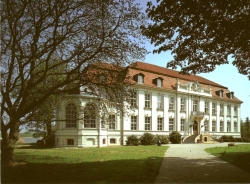
The manor house described by Fontane, built in 1750 by the legendary Prussian hussar general Hans Joachim von Zieten (1699–1786) – known simply as ‘Zieten Castle’ – now serves as a conference venue for the German Judges’ Academy and is situated directly on Lake Ruppin, a few kilometres from Neuruppin, which is said to be ‘the most Prussian of all towns’. Neuruppin, the birthplace of Theodor Fontane and Karl Friedrich Schinkel – arguably the most significant Prussian architect of the early 19th century – is the administrative centre of the Ostprignitz-Ruppin district and is situated on the northern shore of the lake. Well worth a visit – combined with a stroll through the historic old town, characterised by a classical townscape with impressive squares and stately buildings – is the museum with its superbly designed sections on Theodor Fontane, Karl Friedrich Schinkel and the world-famous ‘Neuruppin picture sheets’. From Neuruppin, between May and September, you can take passenger boats on wonderful excursions and sightseeing cruises through the Ruppin Lake District. Last but not least, Neuruppin is the starting point for impressive cycle tours through the scenic ‘Ruppin Switzerland’.
You can find information about the Ruppiner Land at:
Since 2005, the ‘Wustrau Lake Festival’ has been held in the castle grounds and on the lake stage in the castle courtyard each summer, featuring high-calibre theatre and rousing musical productions. A highlight every year is the re-enactment of the ‘lake battle’ between the villages of Wustrau and Karwe, as described by Fontane in his *Wanderungen*.
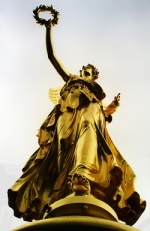
Wustrau and its surroundings are ideal for long walks and cycle rides through a landscape that remains unspoilt and intact. The Linumer Luch is one of Europe’s most important bird sanctuaries and, in autumn, serves as a stopover for 80,000 cranes on their journey south. Near Wustrau, in Hakenberg, the Victory Column, crowned by the imposing statue of Victoria, commemorates the ‘Battle of Fehrbellin’ (1675) and offers visitors a magnificent view of the Markish countryside.
Rheinsberg (castle, Tucholsky Museum), Wittstock (old town, Museum of the Thirty Years’ War), Neustadt an der Dosse (“the Sanssouci of horses”), Berlin and Potsdam can all be reached by car in an hour or thereabouts.
The town and its surroundings
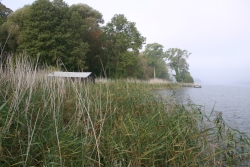
“Wustrau,” writes Theodor Fontane in his *Wanderungen durch die Mark Brandenburg*, “lies at the southern tip of the lake. The soil is fertile, and where the fertility ends, the Wustrau marsh begins – a peat bog that rivals the Linum peat pits in terms of productivity. The village itself, with its neat farmhouses that bear witness to prosperity, lies somewhat set back from the lake; between the village and the lake, however, lies the park, whose clumps of trees are overlooked by the roof of the manor house, which stands on slightly higher ground. The latter resembles, to a hair’s breadth, the noble residences built in the towns and villages of the Mark during the second half of the previous century…”
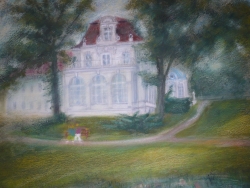
In Wustrau, a unique Brandenburg-Prussian estate complex comprising a castle, church, vicarage and servants’ quarters has been preserved to this day. The lovingly restored church is particularly worth a visit. In the churchyard, you can see the graves of Hans Joachim von Zieten, the old ‘Zieten aus dem Busch’, and his son Friedrich Christian, the long-serving district administrator of the Ruppin district. At the end of 2000, the privately run “Brandenburg–Prussia Museum” opened, offering an “educational trail through five hundred years of Brandenburg-Prussian history”.
The town and its surroundings
“Wustrau,” writes Theodor Fontane in his *Wanderungen durch die Mark Brandenburg*, “lies at the southern tip of the lake. The soil is fertile, and where the fertility ends, the Wustrau marsh begins – a peat bog that rivals the Linum peat pits in terms of productivity. The village itself, with its neat farmhouses that bear witness to prosperity, lies somewhat set back from the lake; between the village and the lake, however, lies the park, whose clumps of trees are overlooked by the roof of the manor house, which stands on slightly higher ground. The latter resembles, to a hair’s breadth, the noble residences built in the towns and villages of the Mark during the second half of the previous century…”
The manor house described by Fontane, built in 1750 by the legendary Prussian hussar general Hans Joachim von Zieten (1699–1786) – known simply as ‘Zieten Castle’ – now serves as a conference venue for the German Judges’ Academy and is situated directly on Lake Ruppin, a few kilometres from Neuruppin, which is said to be ‘the most Prussian of all towns’. Neuruppin, the birthplace of Theodor Fontane and Karl Friedrich Schinkel – arguably the most significant Prussian architect of the early 19th century – is the administrative centre of the Ostprignitz-Ruppin district and is situated on the northern shore of the lake. Well worth a visit – combined with a stroll through the historic old town, characterised by a classical townscape with impressive squares and stately buildings – is the museum with its superbly designed sections on Theodor Fontane, Karl Friedrich Schinkel and the world-famous ‘Neuruppin picture sheets’. From Neuruppin, between May and September, you can take passenger boats on wonderful excursions and sightseeing cruises through the Ruppin Lake District. Last but not least, Neuruppin is the starting point for impressive cycle tours through the scenic ‘Ruppin Switzerland’.
You can find information about the Ruppiner Land at:
In Wustrau, a unique Brandenburg-Prussian estate complex comprising a castle, church, vicarage and servants’ quarters has been preserved to this day. The lovingly restored church is particularly worth a visit. In the churchyard, you can see the graves of Hans Joachim von Zieten, the old ‘Zieten aus dem Busch’, and his son Friedrich Christian, the long-serving district administrator of the Ruppin district. At the end of 2000, the privately run “Brandenburg–Prussia Museum” opened, offering an “educational trail through five hundred years of Brandenburg-Prussian history”.
Since 2005, the ‘Wustrau Lake Festival’ has been held in the castle grounds and on the lake stage in the castle courtyard each summer, featuring high-calibre theatre and rousing musical productions. A highlight every year is the re-enactment of the ‘lake battle’ between the villages of Wustrau and Karwe, as described by Fontane in his *Wanderungen*.
Wustrau and its surroundings are ideal for long walks and cycle rides through a landscape that remains unspoilt and intact. The Linumer Luch is one of Europe’s most important bird sanctuaries and, in autumn, serves as a stopover for 80,000 cranes on their journey south. Near Wustrau, in Hakenberg, the Victory Column, crowned by the imposing statue of Victoria, commemorates the ‘Battle of Fehrbellin’ (1675) and offers visitors a magnificent view of the Markish countryside.
Rheinsberg (castle, Tucholsky Museum), Wittstock (old town, Museum of the Thirty Years’ War), Neustadt an der Dosse (“the Sanssouci of horses”), Berlin and Potsdam can all be reached by car in an hour or thereabouts.
Information
How to get here
Information
How to get here