
Herbert Mertin (Minister of Justice of the State of Rhineland-Palatinate):
50 Years of the German Judges’ Academy, published in:
DRiZ, Issue 5, 2023, p. 175 ff.
The German Judges’ Academy has been based in Trier, Rhineland-Palatinate, for 50 years now and in Wustrau, Brandenburg, for 30 years. The ceremonial opening of the German Judges’ Academy in Trier on 16 February 1973, attended by Dr Gerhard Jahn as Federal Minister of Justice, Dr Helmut Kohl as Minister-President of the State of Rhineland-Palatinate and many other prominent representatives, was rightly regarded as a significant event in the history of the German judiciary and as a successful example of cooperative, practical federalism. The aim was to strengthen the special position of the judiciary and its tasks within the democratic constitutional state, and the establishment of the German Judges’ Academy brought an end to the provisional arrangement of the so-called ‘flying academies’ that had been in use until then.
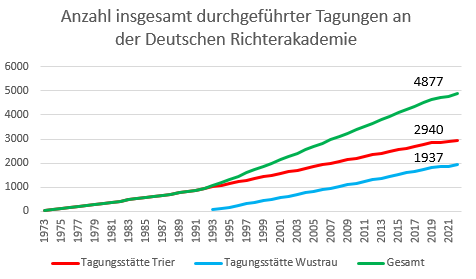
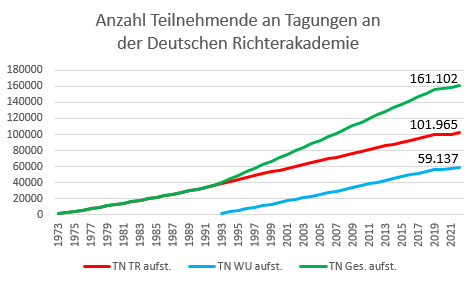
Today, the vast majority of judges and public prosecutors have attended a conference at the German Judges’ Academy at one or more points in their professional careers, at one of its two attractive conference venues. The training courses are universally regarded as an enrichment. Between 1973 and 2022, 4,877 conferences were successfully held at the German Judges’ Academy, with a total of 161,102 participants.
Continuing professional development is essential for judges and public prosecutors to cope with the demands of their daily work. The principle of lifelong learning is therefore a fundamental tenet within the judiciary. The extensive range of training courses offered by the German Judges’ Academy is a striking testament to this. The programme thus encompasses not only training in substantive national and international law but also behaviour-oriented and interdisciplinary conferences.
Visits to the Judges’ Academy are more than mere training sessions. The conference centres in Trier and Wustrau are also meeting places, offering opportunities for collegial contact and the individual exchange of experiences across national borders. For 50 years, speakers from all areas of the legal profession have, with great personal commitment, sharpened our focus on current case law and its development, as well as on the social developments they encounter in their daily professional lives.
Through its comprehensive range of programmes, the German Judges’ Academy thus makes an extraordinary contribution to a realistic, vibrant and robust judiciary, and to the uniform application of federal law.
I would like to thank everyone who has contributed to this enormous success in recent years: the speakers, the staff at the German Judges’ Academy, and the federal and state governments. Naturally, my thanks also go to the city of Trier and the state of Brandenburg, which have been providing wonderful conference venues for an impressive 50 and 30 years respectively. I am also grateful to the federal and state parliaments for their continued funding of the German Judges’ Academy.
For several years now, some courses at the German Judges’ Academy have been held online, although the dominance of the face-to-face format is not to be challenged. The complementary introduction of digital formats offers opportunities for an even higher number of participants and an even better work-life balance. This is to be expanded in future through the implementation of a nationwide e‑learning platform.
The German Judges’ Academy is well positioned for the future, and indeed it must be. For an independent and excellently trained judiciary is and remains the backbone of our constitutional state. This will not change in the next 50 years either. In this regard, care must continue to be taken to ensure adequate funding.
As a representative of the host state of Rhineland-Palatinate, it is my pleasure to warmly congratulate the German Judges’ Academy on its 50th anniversary. I wish it every success in the next 50 years. It has earned it.
Fifty Years of the German Judges’ Academy: Preserving the Best, Embracing Challenges – A Report from the Conference Venues
(by Dr Stephan Jaggi, LL.M., J.S.D. (Yale), Director of the German Judges’ Academy)
The German Judges’ Academy (DRA) was opened on 16 February 1973 and is celebrating its fiftieth anniversary this year. This anniversary gives me the opportunity to take stock of what has stood the test of time in recent years and to discuss the new challenges the Academy has faced and continues to face.
The DRA is the only nationwide training centre for judges and public prosecutors in the Federal Republic of Germany. It has two conference centres, one in Trier (Rhineland-Palatinate) and one in Wustrau (Brandenburg). The conference centre in Trier was opened in 1973, and the one in Wustrau in 1993.
The DRA’s in-person conference programme, which takes place at both of the Academy’s venues, has proven its worth over the past fifty years. This conference programme consists of 55% specialist legal conferences, 25% interdisciplinary conferences and 20% behaviour-oriented conferences. This is as stipulated in the collection of resolutions from the DRA’s Programme Conference. In practice, specialist legal conferences are usually offered slightly more frequently, and interdisciplinary and behaviour-oriented conferences correspondingly less often.
Over the years, we have received positive feedback from participants: judges and public prosecutors from across Germany have been actively attending DRA conferences for years and rate them on average at 8.1 out of a possible 9.0 points. The DRA’s two conference venues achieved an occupancy rate of 92.9% in 2019. The in-person conferences at the venues offer many advantages: in addition to the DRA teams’ warm hospitality and the excellent food, both of which are highly praised at both venues, participants see the main benefit of in-person events as the opportunity to exchange ideas personally and professionally outside of the lectures, during breaks, at meals and in discussions after the lectures have ended. This gives rise to legal discussions that transcend national borders, and the transfer of experience and knowledge from these exchanges benefits the judiciary nationwide.
From 2020 onwards, in-person conferences were no longer possible due to the coronavirus pandemic. Despite all the hurdles and personal strain it caused for everyone affected, the pandemic thus became an opportunity for the DRA to turn its attention to an area that had not yet been fully explored: digitalisation. During the height of the pandemic, the only alternative to a complete shutdown was to hold conferences online. The challenges were enormous and the learning curve for everyone involved was steep. However, in close cooperation with the federal and state judicial administrations, we were soon able to hold online conferences, some with over a hundred participants, with great success.
Digitalisation enabled us to hold many planned conferences as announced. This was undoubtedly a heartening professional highlight and a welcome venue for virtual interaction for many judges and public prosecutors, whose daily working lives had been severely strained by the challenges of the pandemic. We also reached a whole new group of participants in this way. Young parents in particular still see online conferences as an opportunity to undertake further training without having to accept prolonged absences from family and professional commitments. The total number of participants thus rose from almost 4,500 in 2019 to just under 5,500 in 2022. It is also interesting to note that the proportion of female participants rose from 49% in 2019 to 56% in 2022.
However, experience also shows that not every conference is equally suited to the digital medium. Conferences where a very active exchange between participants is the main focus were found to be rather tiring when held online. Short conferences, on the other hand, which are primarily about knowledge transfer, are very well suited to online training. Based on these experiences, the DRA’s programme conference decided that face-to-face events should remain the core business; however, in addition to this core business, the range of digital training courses is to be further expanded in order to give more judges and public prosecutors the opportunity to undertake training tailored to their needs.
The DRA has so far implemented this directive by initially including twenty additional online conferences in the programme for 2021. In addition, the hybrid conference format was introduced, whereby participants join online alongside those attending in person. Those joining online can communicate with the in-person participants with virtually no restrictions. I have already outlined the result of these innovations above: a significant increase in the total number of participants of around 20% from 2019 to 2022. However, feedback from participants also shows that it was the right decision not to alter the in-person conferences, which remain the DRA’s core business. With their opportunities for informal, direct exchange, they offer advantages that digital events do not have. Digital events primarily serve to reach groups of participants who, for professional or personal reasons, have hitherto been unable or barely able to take advantage of the DRA’s training programme. The systematic digitalisation of the DRA’s training programme thus offers more participants the opportunity to undertake further training. Since 2022, two additional IT staff members at the DRA have been tasked with managing the expanded digital training programme and providing the necessary technical support.
As a next step, the DRA launched an e‑learning platform in February 2023. This platform initially makes two e‑learning modules available to all judges and public prosecutors in the Federal Republic of Germany: one on intercultural competence and one on digital competence. These are two of a total of three e‑learning modules for which the Federal Government commissioned the development of an e‑learning platform as part of the 2019 Pact for the Rule of Law. At www.e‑justizfortbildungen.de, the training programme for judges and public prosecutors is being expanded to include e‑learning courses. The third module on psychological competence is still in development and is due to be made available to interested parties in the near future. Finally, with the support of the European Judicial Training Network (EJTN), the DRA has acquired so-called Zoom Room technology, which will be used to offer digital judicial training across the EU in future.
Overall, the pandemic has thus given the DRA a digitalisation boost from which judicial training nationwide is benefiting and on which it can build in the future. We therefore look forward with great anticipation to the next fifty years of the DRA.
You can read a further article on the DRA’s 50th anniversary via the link below: Süddeutsche Zeitung article.
Herbert Mertin (Minister of Justice of the State of Rhineland-Palatinate):
50 Years of the German Judges’ Academy, published in:
DRiZ, Issue 5, 2023, p. 175 ff.
The German Judges’ Academy has been based in Trier, Rhineland-Palatinate, for 50 years now and in Wustrau, Brandenburg, for 30 years. The ceremonial opening of the German Judges’ Academy in Trier on 16 February 1973, attended by Dr Gerhard Jahn as Federal Minister of Justice, Dr Helmut Kohl as Minister-President of the State of Rhineland-Palatinate and many other prominent representatives, was rightly regarded as a significant event in the history of the German judiciary and as a successful example of cooperative, practical federalism. The aim was to strengthen the special position of the judiciary and its tasks within the democratic constitutional state, and the establishment of the German Judges’ Academy brought an end to the provisional arrangement of the so-called ‘flying academies’ that had been in use until then.
Today, the vast majority of judges and public prosecutors have attended a conference at the German Judges’ Academy at one or more points in their professional careers, at one of its two attractive conference venues. The training courses are universally regarded as an enrichment. Between 1973 and 2022, 4,877 conferences were successfully held at the German Judges’ Academy, with a total of 161,102 participants.
Continuing professional development is essential for judges and public prosecutors to cope with the demands of their daily work. The principle of lifelong learning is therefore a fundamental tenet within the judiciary. The extensive range of training courses offered by the German Judges’ Academy is a striking testament to this. The programme thus encompasses not only training in substantive national and international law but also behaviour-oriented and interdisciplinary conferences.
Visits to the Judges’ Academy are more than mere training sessions. The conference centres in Trier and Wustrau are also meeting places, offering opportunities for collegial contact and the individual exchange of experiences across national borders. For 50 years, speakers from all areas of the legal profession have, with great personal commitment, sharpened our focus on current case law and its development, as well as on the social developments they encounter in their daily professional lives.
Through its comprehensive range of programmes, the German Judges’ Academy thus makes an extraordinary contribution to a realistic, vibrant and robust judiciary, and to the uniform application of federal law.
I would like to thank everyone who has contributed to this enormous success in recent years: the speakers, the staff at the German Judges’ Academy, and the federal and state governments. Naturally, my thanks also go to the city of Trier and the state of Brandenburg, which have been providing wonderful conference venues for an impressive 50 and 30 years respectively. I am also grateful to the federal and state parliaments for their continued funding of the German Judges’ Academy.
For several years now, some courses at the German Judges’ Academy have been held online, although the dominance of the face-to-face format is not to be challenged. The complementary introduction of digital formats offers opportunities for an even higher number of participants and an even better work-life balance. This is to be expanded in future through the implementation of a nationwide e‑learning platform.
The German Judges’ Academy is well positioned for the future, and indeed it must be. For an independent and excellently trained judiciary is and remains the backbone of our constitutional state. This will not change in the next 50 years either. In this regard, care must continue to be taken to ensure adequate funding.
As a representative of the host state of Rhineland-Palatinate, it is my pleasure to warmly congratulate the German Judges’ Academy on its 50th anniversary. I wish it every success in the next 50 years. It has earned it.
Fifty Years of the German Judges’ Academy: Preserving the Best, Embracing Challenges – A Report from the Conference Venues
(by Dr Stephan Jaggi, LL.M., J.S.D. (Yale), Director of the German Judges’ Academy)
The German Judges’ Academy (DRA) was opened on 16 February 1973 and is celebrating its fiftieth anniversary this year. This anniversary gives me the opportunity to take stock of what has stood the test of time in recent years and to discuss the new challenges the Academy has faced and continues to face.
The DRA is the only nationwide training centre for judges and public prosecutors in the Federal Republic of Germany. It has two conference centres, one in Trier (Rhineland-Palatinate) and one in Wustrau (Brandenburg). The conference centre in Trier was opened in 1973, and the one in Wustrau in 1993.
The DRA’s in-person conference programme, which takes place at both of the Academy’s venues, has proven its worth over the past fifty years. This conference programme consists of 55% specialist legal conferences, 25% interdisciplinary conferences and 20% behaviour-oriented conferences. This is as stipulated in the collection of resolutions from the DRA’s Programme Conference. In practice, specialist legal conferences are usually offered slightly more frequently, and interdisciplinary and behaviour-oriented conferences correspondingly less often.
Over the years, we have received positive feedback from participants: judges and public prosecutors from across Germany have been actively attending DRA conferences for years and rate them on average at 8.1 out of a possible 9.0 points. The DRA’s two conference venues achieved an occupancy rate of 92.9% in 2019. The in-person conferences at the venues offer many advantages: in addition to the DRA teams’ warm hospitality and the excellent food, both of which are highly praised at both venues, participants see the main benefit of in-person events as the opportunity to exchange ideas personally and professionally outside of the lectures, during breaks, at meals and in discussions after the lectures have ended. This gives rise to legal discussions that transcend national borders, and the transfer of experience and knowledge from these exchanges benefits the judiciary nationwide.
From 2020 onwards, in-person conferences were no longer possible due to the coronavirus pandemic. Despite all the hurdles and personal strain it caused for everyone affected, the pandemic thus became an opportunity for the DRA to turn its attention to an area that had not yet been fully explored: digitalisation. During the height of the pandemic, the only alternative to a complete shutdown was to hold conferences online. The challenges were enormous and the learning curve for everyone involved was steep. However, in close cooperation with the federal and state judicial administrations, we were soon able to hold online conferences, some with over a hundred participants, with great success.
Digitalisation enabled us to hold many planned conferences as announced. This was undoubtedly a heartening professional highlight and a welcome venue for virtual interaction for many judges and public prosecutors, whose daily working lives had been severely strained by the challenges of the pandemic. We also reached a whole new group of participants in this way. Young parents in particular still see online conferences as an opportunity to undertake further training without having to accept prolonged absences from family and professional commitments. The total number of participants thus rose from almost 4,500 in 2019 to just under 5,500 in 2022. It is also interesting to note that the proportion of female participants rose from 49% in 2019 to 56% in 2022.
However, experience also shows that not every conference is equally suited to the digital medium. Conferences where a very active exchange between participants is the main focus were found to be rather tiring when held online. Short conferences, on the other hand, which are primarily about knowledge transfer, are very well suited to online training. Based on these experiences, the DRA’s programme conference decided that face-to-face events should remain the core business; however, in addition to this core business, the range of digital training courses is to be further expanded in order to give more judges and public prosecutors the opportunity to undertake training tailored to their needs.
The DRA has so far implemented this directive by initially including twenty additional online conferences in the programme for 2021. In addition, the hybrid conference format was introduced, whereby participants join online alongside those attending in person. Those joining online can communicate with the in-person participants with virtually no restrictions. I have already outlined the result of these innovations above: a significant increase in the total number of participants of around 20% from 2019 to 2022. However, feedback from participants also shows that it was the right decision not to alter the in-person conferences, which remain the DRA’s core business. With their opportunities for informal, direct exchange, they offer advantages that digital events do not have. Digital events primarily serve to reach groups of participants who, for professional or personal reasons, have hitherto been unable or barely able to take advantage of the DRA’s training programme. The systematic digitalisation of the DRA’s training programme thus offers more participants the opportunity to undertake further training. Since 2022, two additional IT staff members at the DRA have been tasked with managing the expanded digital training programme and providing the necessary technical support.
As a next step, the DRA launched an e‑learning platform in February 2023. This platform initially makes two e‑learning modules available to all judges and public prosecutors in the Federal Republic of Germany: one on intercultural competence and one on digital competence. These are two of a total of three e‑learning modules for which the Federal Government commissioned the development of an e‑learning platform as part of the 2019 Pact for the Rule of Law. At www.e‑justizfortbildungen.de, the training programme for judges and public prosecutors is being expanded to include e‑learning courses. The third module on psychological competence is still in development and is due to be made available to interested parties in the near future. Finally, with the support of the European Judicial Training Network (EJTN), the DRA has acquired so-called Zoom Room technology, which will be used to offer digital judicial training across the EU in future.
Overall, the pandemic has thus given the DRA a digitalisation boost from which judicial training nationwide is benefiting and on which it can build in the future. We therefore look forward with great anticipation to the next fifty years of the DRA.
You can read a further article on the DRA’s 50th anniversary via the link below: Süddeutsche Zeitung article.
Information
How to get here
Information
How to get here